
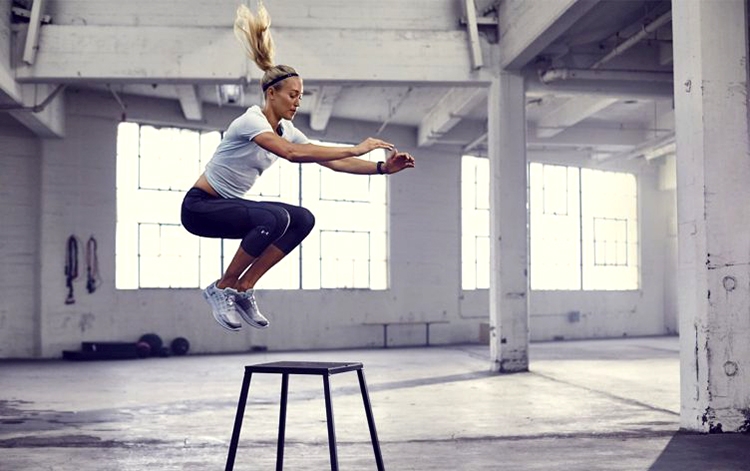
When most people hear "plyometrics," they picture basketball players doing box jumps or volleyball players training their vertical. And sure, plyometric training is a staple for those sports. But if you're a runner, a cyclist, a swimmer, a recreational soccer player, or just someone who lifts weights and wants to stay athletic, you might think plyos don't really apply to you.
That thinking is costing you performance and leaving you more vulnerable to injury than you realize.
Plyometric training isn't just for athletes who jump for a living. It's for any athlete whose body needs to produce force quickly, absorb impact efficiently, and stay resilient under repeated loading. Which, when you think about it, is pretty much everyone.
What Is Plyometric Training, Actually?
Let's clear up the definition. Plyometric training refers to exercises that train the stretch-shortening cycle (SSC), the ability of a muscle and tendon to rapidly load, store energy, and then release that energy explosively.
Think of it like a spring. When a spring is compressed quickly and then released, it returns that energy efficiently. Your muscles and tendons work the same way. When you land from a jump, step off a curb, or absorb a tackle, your body loads eccentrically (lengthens under tension) and then needs to rapidly transition into a concentric (shortening) contraction to produce force in the opposite direction.
The speed of that transition, what we call the amortization phase, is trainable. And training it is what plyometrics is all about.
True plyometric exercises include things like depth jumps, broad jumps, bounding, sprint drills, reactive cutting, lateral hops, and yes, box jumps. But the category is much broader than most people think, and the principles apply far beyond the weight room.
The Stretch-Shortening Cycle in Everyday Sport
Here's why this matters across every sport and activity:
Running is entirely plyometric. Every single stride involves your foot striking the ground, your ankle and calf loading eccentrically, and then rapidly transitioning to push off. If that spring mechanism is weak or poorly trained, you lose energy with every step, and your tendons and joints absorb more stress than they should. This is a major contributing factor to Achilles tendinopathy, plantar fasciitis, and stress fractures in runners who've never done any plyometric training.
Cutting and change of direction in field and court sports, soccer, lacrosse, basketball, tennis, are fundamentally deceleration-then-acceleration tasks. The body has to absorb force rapidly and redirect it. Without a trained SSC, that absorption gets absorbed passively by the ligaments and joints rather than actively by the muscles. That's the ACL injury story in a nutshell.
Throwing and overhead sports baseball, softball, volleyball, tennis, require rapid loading and unloading through the shoulder, trunk, and hip complex. Rotational power comes from a coordinated SSC through the entire kinetic chain. Without it, you can't generate maximal power, and you're more likely to overload vulnerable structures trying to compensate.
Recreational lifting — this one surprises people. If you lift weights but never train explosively, your body gets strong through a slow, controlled range of motion but loses the ability to produce force quickly. That's fine for the gym. It's not fine for life, recreation, or sport, where you need to catch yourself from a trip, brace for impact, or sprint to a ball without thinking.
Why Plyos Aren't Just About Jumping Higher
The benefits of plyometric training extend well beyond vertical leap:
Tendon health and resilience. Tendons adapt to plyometric loading differently than they adapt to slow, heavy strength training. High-speed, repetitive loading through the SSC trains tendons to become stiffer, more energy-efficient, and more resistant to cumulative stress. In fact, progressive plyometric loading is one of the primary rehabilitation tools we use for tendinopathy, because tendons need this type of stimulus to fully recover and prevent recurrence.
Rate of force development (RFD). This is the speed at which your muscles can produce force — and it's one of the most important qualities for athletic performance. Traditional strength training improves maximum force output. Plyometric training improves how fast you can get there. In sport, most actions happen in 100–250 milliseconds. Maximal strength doesn't matter much if you can't access it that quickly.
Neuromuscular coordination. Plyometrics train the nervous system to recruit motor units rapidly and in the right sequence. This improves not just power, but coordination, balance, and reactive ability, the kind of athleticism that helps you stay upright when you land awkwardly or change direction without thinking.
Injury resilience through load tolerance. Progressive plyometric training systematically exposes your tendons, muscles, and bones to impact loading, which builds their capacity to tolerate that loading over time. Athletes who avoid all high-impact training don't become more durable. They become less tolerant of impact, and then when sport demands it anyway, they're unprepared.
Plyometrics for Runners: A Special Case
We need to talk about this one specifically because it's so commonly misunderstood.
Many runners avoid any training that looks "gym-like", they feel like more running is always the answer. But running is a high-repetition, single-leg plyometric activity, and the Achilles, calf complex, and plantar fascia take thousands of SSC cycles per mile. If those structures aren't trained with progressive plyometric loading in addition to running volume, they are consistently underprepared for the demands being placed on them.
The research is clear: runners who incorporate plyometric training improve running economy (the efficiency of oxygen use at a given pace), reduce injury rates, and often improve performance times — particularly at longer distances where fatigue starts to degrade form.
A basic runner's plyometric progression looks like this:
- Phase 1: Double-leg jump landings, pogos, skipping for height
- Phase 2: Single-leg hops, bounding, lateral hops
- Phase 3: Reactive drills, single-leg depth drops, acceleration mechanics
This isn't instead of running. It's what makes your running sustainable.
Plyometrics and Injury Rehabilitation
This is where performance PT and plyometric training intersect in a really important way.
One of the biggest gaps in traditional rehabilitation is what we call the "return-to-sport gap", the space between when someone stops limping and when they're actually ready to perform at full intensity. Most standard rehab programs get people out of pain and moving well, but they never address power, reactive ability, or high-speed loading. So athletes return to sport and reinjure because they've never rebuilt the qualities that sport demands.
At Conquer Movement, plyometric progressions are a core part of our return-to-sport protocols, for runners coming back from stress fractures, for basketball players returning from ankle sprains, for soccer players post-ACL reconstruction, for anyone who needs to go from "pain-free" to "performance-ready."
We use plyometrics diagnostically too. How does an athlete land? Do they load symmetrically? Can they absorb force without the knee caving or the trunk collapsing? The answers tell us a lot about readiness for full return and where the remaining gaps are.
How to Start: Plyometric Progressions for Non-Jumping Athletes
If you've never done structured plyometric training, the starting point isn't box jumps, it's landing mechanics and low-level reactive work. Here's a general framework:
Beginners — Build the Foundation
- Squat jumps with soft landing emphasis
- Broad jumps (focus on landing control, not distance)
- Lateral shuffle bounds
- Double-leg pogos (small, continuous hops focusing on ground contact time)
Intermediate — Add Load and Reactivity
- Box jumps with step-down (not jump-down) return
- Single-leg hops for distance
- Lateral bounds
- Medicine ball slams and rotational throws
Advanced — Sport-Specific and Reactive
- Depth drops and depth jumps
- Reactive change of direction drills
- Single-leg bounding
- Sprint mechanics and acceleration work
The key variable across all levels is ground contact time — specifically, training it to decrease. The ability to get on and off the ground (or to load and unload) quickly is the entire point of the exercise. If every jump looks slow and heavy, you're building strength but not the SSC.
Programming Considerations
A few important notes on how to incorporate plyometric training intelligently:
Fatigue management matters. Plyometrics should be performed early in a session, when the nervous system is fresh. Doing box jumps at the end of a brutal leg day after you're already exhausted defeats the purpose and increases injury risk.
Volume and intensity are inversely related. High-intensity plyos (depth jumps, single-leg reactive hops) are performed in lower volume. Lower-intensity plyos (skipping, broad jumps) can be performed in higher volume. Don't max out on both at the same time.
Progression is mandatory. You can't jump straight to advanced plyometric work without building the foundation first. Landing mechanics, single-leg stability, and eccentric strength all need to be in place before high-intensity reactive work.
Rest between sets. Plyometric training is power training — it requires rest. Unlike conditioning circuits where you're trying to maintain output under fatigue, plyos need near-full recovery between sets so each rep is explosive and of high quality.
The Bottom Line
Plyometric training is not a niche tool for elite jumpers. It's a fundamental athletic quality that every active person needs — because force absorption, reactive strength, and rate of force development are part of every sport and most activities of daily life.
Train your spring. Build your tendons. Teach your nervous system to respond faster. Whether you're a runner logging 40 miles a week, a rec league soccer player, or a masters athlete who wants to stay athletic into your 50s and 60s — plyometrics belong in your program.
Ready to Build a More Resilient, Powerful Body?
If you want to know whether your training is actually preparing you for the physical demands of your sport or activity — or if you've been dealing with recurring injuries that keep interrupting your progress — we'd love to connect.
Schedule a free discovery call with Conquer Movement Performance Physical Therapy in Wilmington, NC. We'll assess where you are, identify the gaps, and build a plan that takes you from where you are to where you want to be.
Book Your Free Discovery Call →
Dr. Evan Langley, DPT
Conquer Movement Performance Physical Therapy
Wilmington, NC
Dr. Evan Langley is a performance physical therapist at Conquer Movement in Wilmington, NC, specializing in working with athletes, runners, and active adults who want to stay in the game.